You might have already come across some Chinese proverbs from Confucius and his students. Not only are they meaningful and thought-provoking, but it can be said that many people still follow the philosophical ideals of Confucius.
Confucius, known as 孔子 (kǒng zi), was born around 550 B.C, but little is factually known about his background. What is known, is based on his philosophical teachings and wisdom through the book of Analects, 论语 (lún yǔ). His teachings came at a time when social morals were declining and he saw an opportunity to educate the population in the ethics of family and social values. His most well known and valued principle is known as the Golden Rule:
“己所不欲,勿施于人。” – What you do not wish for yourself, do not do to others. (Analects 12.2, 6.30)
Confucius believed that above all else, people should show love for each other.
Although some of the original proverbs of Confucius may be complex for a beginner of Chinese, the quotes from his most well-known book, Analects have been translated and explained more thoroughly by sinologists such as James Legge.
The following quotes have been taken from Legge’s translation of Analects:
1. Take pleasure in study and hard work
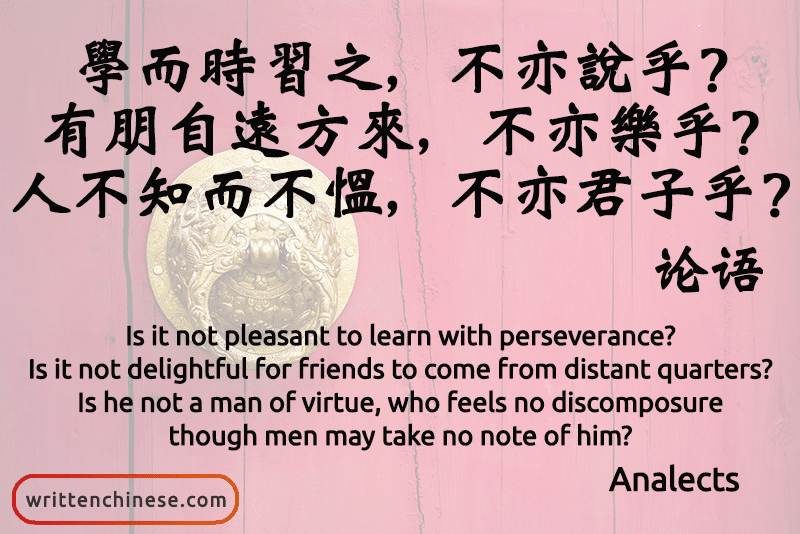
子曰:“學而時習之,不亦說乎?有朋自遠方來,不亦樂乎?人不知而不慍,不亦君子乎?”
(zǐ yuē xué ér shí xí zhī, bù yì shuì hū? yǒu péng zì yuǎn fāng lái, bú yì lè hū? rén bù zhī ér bù yùn, bù yì jūn zi hū?)
The Master (Confucius) said, “Is it not pleasant to learn with a constant perseverance and application? Is it not delightful to have friends coming from distant quarters? Is he not a man of complete virtue, who feels no discomposure though men may take no note of him?”
The idea is that a person who feels achievement from hard work and knowledge and gains respect from others is a virtuous man, even if he doesn’t gain fame from his work.
2. Be sincere and follow the practices of our teachers.
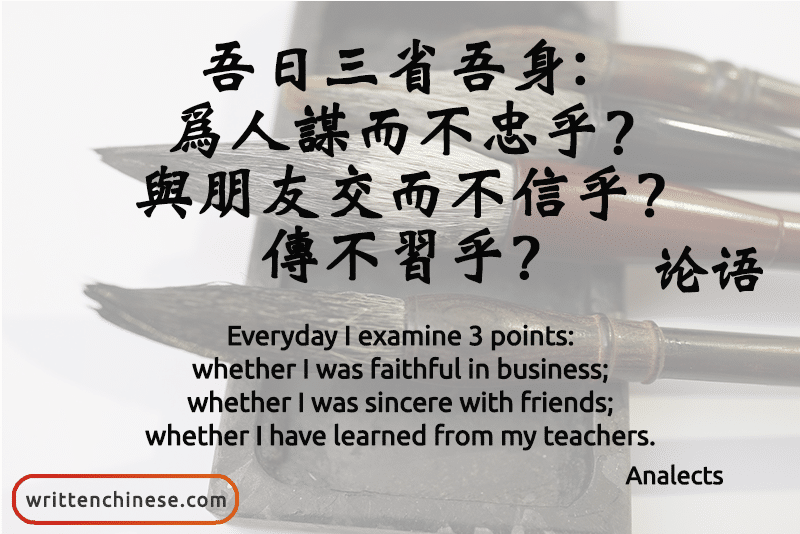
曾子曰:“吾日三省吾身:爲人謀而不忠乎?與朋友交而不信乎?傳不習乎?”
(zēng zǐ yuē: wú rì sān xǐng wú shēn: wéi rén móu ér bù zhōng hū? yǔ péng you jiāo ér bù xìn hū? chuán bù xí hū?)
The philosopher Tsang said, “I daily examine myself on three points:– whether, in transacting business for others, I may have been not faithful;– whether, in intercourse with friends, I may have been not sincere;– whether I may have not mastered and practiced the instructions of my teacher.”
The philosopher Tsang examined himself daily to make sure that he was never guilty of anything that may cause him or others grief.
3. Know your fellow man

(zǐ yuē: bù huàn rén zhī bù jǐ zhī, huàn bù zhī rén yě.)
The Master said, “I will not be afflicted at men’s not knowing me; I will be afflicted that I do not know men.
Confucius tells us that by getting to know others around us we will be able to improve ourselves. Without others, we are unable to learn about our own self.
4. To teach others you need continuous personal improvement
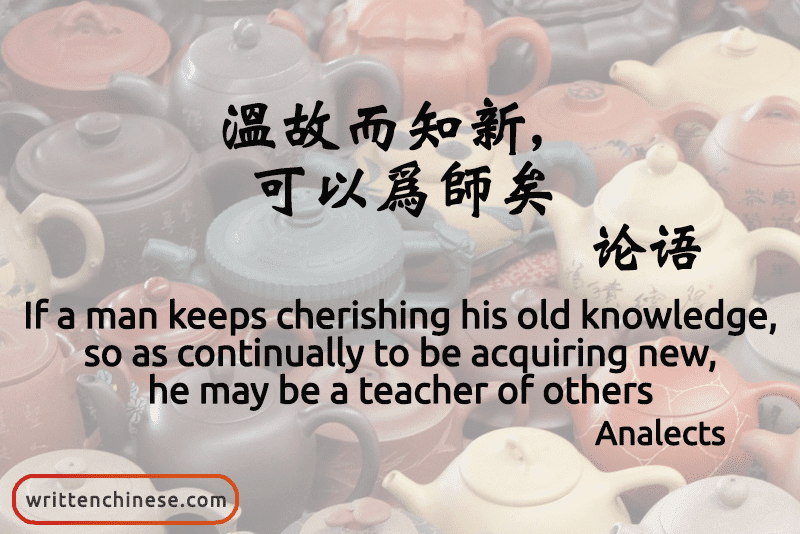
(zǐ yuē: wēn gù ér zhī xīn, kě yǐ wéi shī yǐ.)
The Master said, “If a man keeps cherishing his old knowledge, so as continually to be acquiring new, he may be a teacher of others.”
Only if review our old knowledge and continue to learn new things are we able to teach others.
5. Learning is only possible with reading and thought
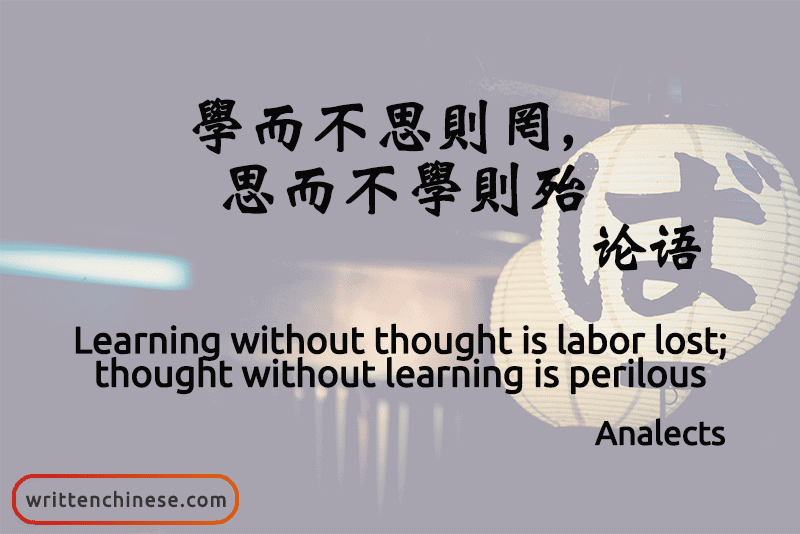
(zǐ yuē: xué ér bù sī zé wǎng, sī ér bù xué zé dài.)
The Master said, “Learning without thought is labor lost; thought without learning is perilous.”
Learning does not happen by just reading a text, we also need to use thought to make sense of it and consider how to apply it to our lives.
6. Know the right way to live life

(zǐ yuē: zhāo wén dào, xī sǐ kě yǐ!)
The Master said, “If a man in the morning hears the right way, he may die in the evening without regret.”
Follow the correct path day to day and we won’t die feeling regretful.
7. Look to others to learn lessons about ourselves

(zǐ yuē: jiàn xián sī qí yān, jiàn bù xián ér nèi zì xǐng yě.)
The Master said, “When we see men of worth, we should think of equaling them; when we see men of a contrary character, we should turn inwards and examine ourselves.”
We can improve ourselves by looking at the characters of others. If we see a good man, then we should follow his example. If, on the other hand, we see a bad person then we should look at our own selves to learn the lesson.
8. Be Neighbourly
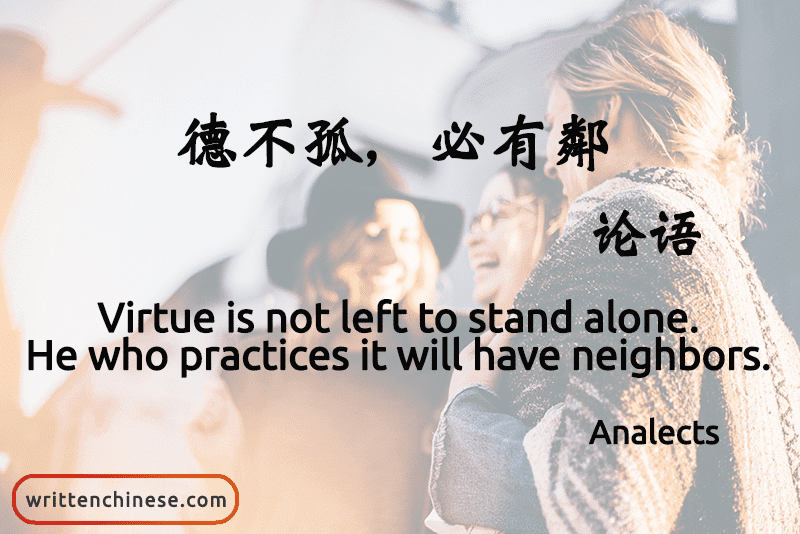
(zǐ yuē: dé bù gū, bì yǒu lín.)
The Master said, “Virtue is not left to stand alone. He who practices it will have neighbours.”
If you’re virtuous there’ll always be like-minded people around you.
9. Stages of Attainment
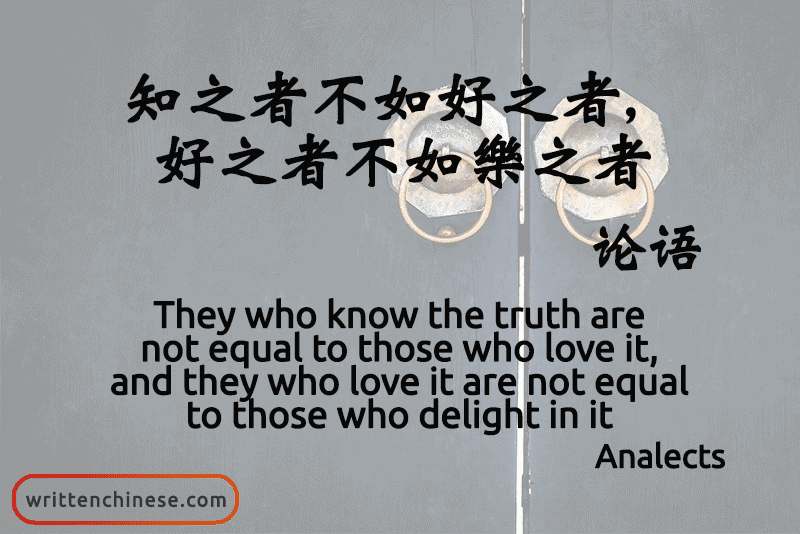
(zǐ yuē: zhī zhī zhě bù rú hǎo zhī zhě, hǎo zhī zhě bù rú lè zhī zhě.)
The Master said, “They who know the truth are not equal to those who love it, and they who love it are not equal to those who delight in it.”
10. Being Wise and Virtuous
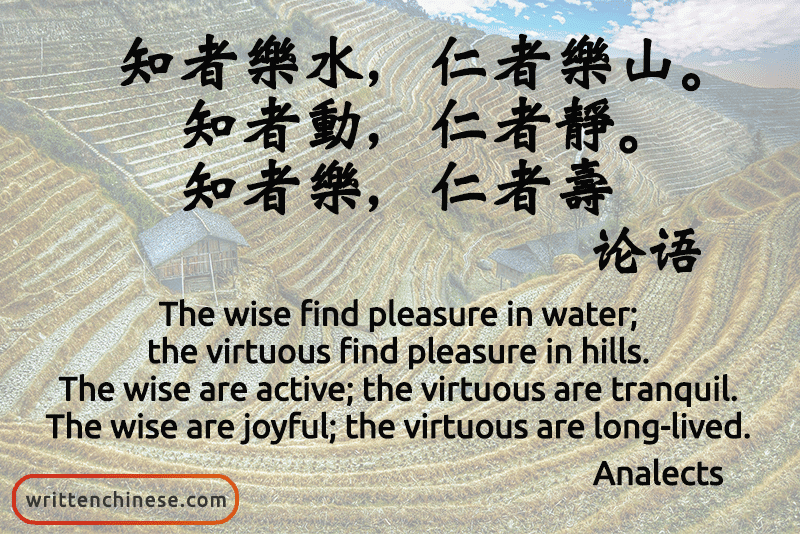
子曰:“知者樂水,仁者樂山。知者動,仁者靜。知者樂,仁者壽。”
(zǐ yuē: zhī zhě lè shuǐ, rén zhě lè shān, zhī zhě dòng, rén zhě jìng, zhī zhě lè, rén zhě shòu.)
The Master said, “The wise find pleasure in water; the virtuous find pleasure in hills. The wise are active; the virtuous are tranquil. The wise are joyful; the virtuous are long-lived.”
If you would like to share your thoughts on any Chinese proverbs, please leave them in the comments below.